
Can You Monetize AI Documentary Videos on YouTube?
When can AI documentaries qualify for YouTube monetization? Review originality, rights, disclosure, channel policy, and ad suitability.
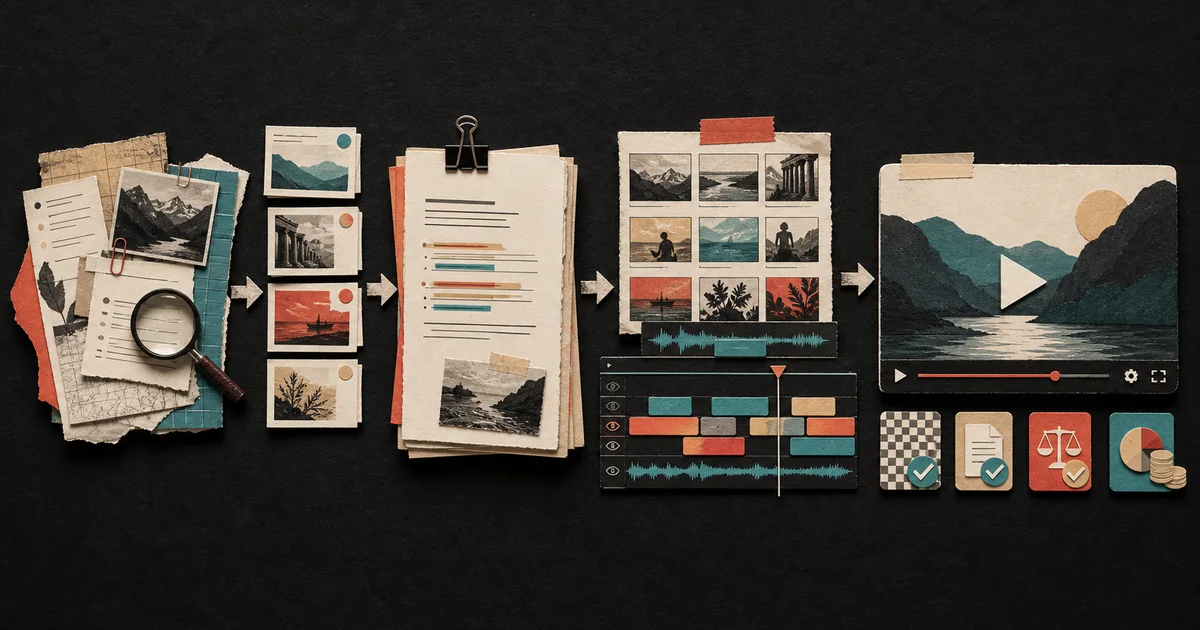
Yes, an AI documentary video can be monetized on YouTube. AI use itself is not the ban. Approval depends on original and authentic value, a channel-wide policy review, commercial rights to every element, advertiser-friendly presentation, and required AI disclosure. Meeting those conditions improves eligibility, but it never guarantees acceptance into the YouTube Partner Program.
The practical question is not “Did AI touch this video?” It is “Can a reviewer and a viewer clearly see the research, judgment, storytelling, and production choices that make this documentary distinct?” YouTube’s current monetization policy explicitly gives allowed examples involving AI-assisted scripts, unique background visuals, and original AI-generated characters. It also rejects generic, repetitive, deceptive, or incoherent output.
AI documentary monetization: the decision table
No row guarantees a decision. YouTube reviews context across the whole channel.
| Production pattern | Why it matters | Practical assessment |
|---|---|---|
| Original thesis, researched script, deliberate edit, licensed media | Shows authorship, educational value, and rights clearance | Stronger basis for review, subject to every other policy |
| AI helps outline, draft, visualize, or edit a distinct story | YouTube lists creative AI assistance as an allowed example when the result has value | Potentially monetizable; judge the finished work, not the tool label |
| Licensed stock clips with substantial narration and transformation | Rights and a meaningful difference from the source both matter | Possible, but permission alone does not resolve reused-content concerns |
| Template repeated across many topics with minimal variation | Can look generic, repetitive, or mass-produced at channel level | High monetization risk |
| Copied clips, article readings, or compilations with light edits | May fail reused-content rules even without a copyright claim | High monetization risk |
| Realistic synthetic event or person shown without disclosure | YouTube requires disclosure for realistic, meaningful AI alteration or generation | Policy risk; repeated non-disclosure can bring penalties |
The five tests your channel still has to pass
1. Original and authentic value
YouTube’s channel monetization policy says monetized content should be original and authentic. It should not be mass-produced, generic, repetitive, or manipulative. Similar formats are not automatically a problem: a channel may keep the same intro, outro, or broad series format when the substance of each video is materially different.
For an AI documentary, originality should be visible in the thesis, evidence, narration, visuals, and edit. Changing only the topic name inside the same template is weak evidence of authorship. A series can share a visual identity, but every film still needs its own question, reporting, arc, and conclusion.
YouTube allows creative tools inside a unique, well-researched narrative. Unrelated AI clips, repetitive formulas, deceptive synthetic events, and generic templates can be ineligible.
2. Reused content is separate from copyright
Reused-content review asks whether you added significant original commentary, substantive modification, or educational or entertainment value. That is different from a copyright claim. YouTube states that a channel may fail reused-content review even when the creator has permission to use the source material.
This distinction matters for documentaries. A licensed archive clip or stock sequence can still sit inside a weak compilation. Rights answer “May I use this?” Transformation answers “What did I contribute?” Narration, analysis, annotation, maps, timelines, and a purposeful edit make that contribution easier to recognize.
3. You need commercial rights
YouTube’s monetizable-content guidance requires the necessary commercial-use rights for visual and audio elements. “Royalty-free” does not always mean unrestricted. An AI image model, voice service, music library, stock site, archive, font, or editing asset can have its own license and account-level terms.
Keep a rights log with each asset, source, license, date, attribution, and proof of permission. This is operational advice, not a legal determination. Get qualified legal advice when a material ownership question is unclear.
4. Advertiser friendliness is a separate decision
Joining YPP does not make every video suitable for all ads. YouTube evaluates the video, title, thumbnail, description, and tags under its advertiser-friendly content guidelines. Violence, tragedy, controversial issues, shocking imagery, and sensitive events can receive limited or no ads depending on focus, graphicness, tone, and context.
Documentary context can matter, but the label is not a shield. Explain why sensitive material is necessary, avoid exploitative thumbnails, and contextualize disturbing material. A factual film and a sensational compilation can receive different treatment.
5. Disclose realistic AI content when required
YouTube’s AI disclosure guidance requires creators to use the upload-flow disclosure when AI meaningfully generates or alters realistic content. Examples include making a real person appear to act or speak, altering footage of a real event or place, or generating a realistic event that did not occur.
Minor help such as outlines, captions, title ideas, infographics, audio repair, or cloning your own voice does not necessarily require disclosure under the published examples. YouTube says a required label does not itself limit the audience or affect earnings eligibility. Repeated non-disclosure can lead to labels or penalties, including YPP suspension.
What a monetizable AI documentary pattern looks like
A stronger pattern makes human authorship and viewer value obvious:
- You choose a defensible question instead of copying a trending title.
- You verify facts against primary or reliable sources and preserve a research trail.
- You write or substantially reshape the script around a specific argument.
- You select scenes because they explain the story, not because they are easy to generate.
- You add maps, dates, citations, diagrams, or comparisons where they improve understanding.
- You control pacing, sound, captions, and visual continuity in the edit.
- You clear commercial rights and disclose realistic AI scenes when required.
- Your title and thumbnail accurately represent what the film proves.
The faceless YouTube workflow starts with the promise and conflict before asset generation. The video idea frameworks can help turn a broad subject into a distinct angle rather than another interchangeable summary.
Patterns that create avoidable risk
Watch for these signals across the whole channel:
- Dozens of videos use the same sentence structure, pacing, thumbnail, and scene order with only nouns changed.
- The narration simply reads an article, news feed, encyclopedia entry, or another creator’s script.
- Stock or social clips carry most of the value while commentary is brief or generic.
- AI visuals contradict the narration, fabricate evidence, or depict real events without clear context.
- A synthetic host presents health, legal, financial, or political advice as a human expert. YouTube’s current policy specifically bars monetization for AI personas delivering advice on those sensitive topics.
- The thumbnail invents a death, disaster, arrest, quote, or discovery that the documentary cannot support.
- Music, voices, images, footage, or fonts have unclear commercial terms.
- Required realistic-AI disclosure is skipped because the creator fears the label.
Faceless does not mean authorless. Your authorship can show through reporting, writing, explanation, graphic design, source notes, and editing even when your face never appears. See the broader faceless video maker guide for a production-focused workflow.
A practical production process before you apply
- Define the original contribution. Write one sentence describing what this film explains that a basic summary does not.
- Keep the research trail. Save source URLs, access dates, notes, and the claim each source supports.
- Plan visual evidence. Decide where the viewer needs an archive, map, timeline, chart, quotation, reconstruction, or generated illustration.
- Record rights as you work. Do not postpone license checks until the upload screen.
- Review the rough cut as a stranger. Ask whether it has a clear beginning, progression, and conclusion, and whether every scene supports the narration.
- Run a policy pass. Check originality, reused content, commercial rights, Community Guidelines, advertiser friendliness, and AI disclosure separately.
- Audit the channel, not only the newest video. Reviewers may focus on the main theme, most-viewed and newest uploads, watch-time leaders, metadata, and About section.
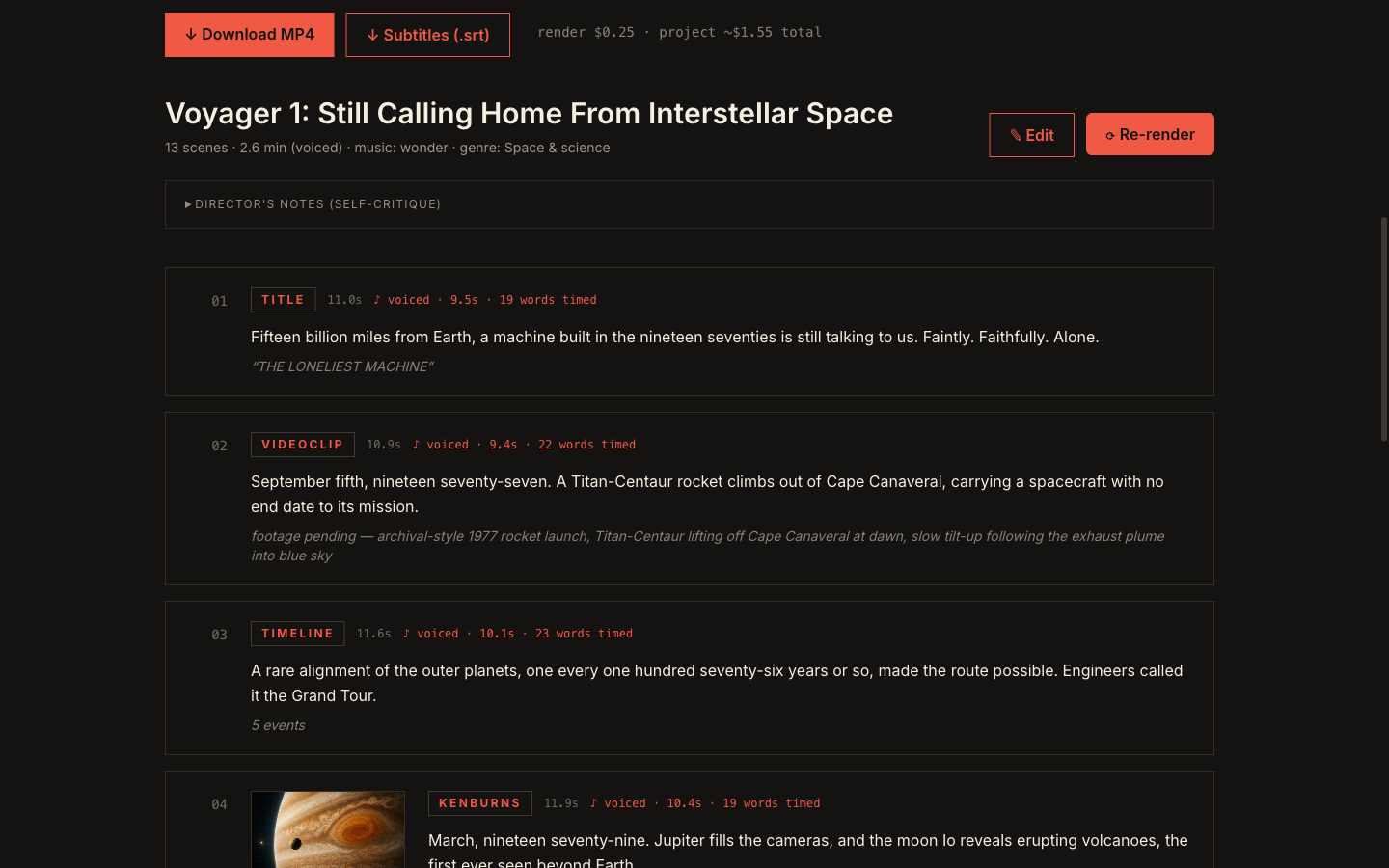
Our AI documentary creation guide expands this process from topic selection to final render. Budget for the review work as well as generation; the AI documentary cost guide explains how revisions, rights, and unused production capacity affect the real cost.
Pre-publication monetization checklist
Before uploading, answer each item with evidence:
- The documentary has a specific thesis, not only a topic.
- The script adds original research, analysis, commentary, or storytelling.
- Each borrowed element is substantially integrated into the explanation.
- Commercial-use rights are documented for footage, images, music, voices, fonts, and generated assets.
- Factual claims, dates, names, quotations, maps, and charts were checked.
- Realistic synthetic scenes cannot be mistaken for archival evidence without context.
- The YouTube “AI use” disclosure is selected when the current policy requires it.
- Sensitive material has educational or documentary context and is not exploitative.
- The title, thumbnail, description, and tags accurately describe the film.
- Captions, pronunciation, audio levels, and visual continuity received a human review.
- The channel’s recent and most-viewed videos also show meaningful variation and value.
- The current official YouTube policies were checked on the upload date.
YPP thresholds do not equal automatic approval
As of July 19, 2026, ad and YouTube Premium revenue sharing generally requires 1,000 subscribers plus either 4,000 valid public watch hours in the previous 12 months or 10 million valid public Shorts views in 90 days. YouTube also offers earlier access to some fan-funding and Shopping features in eligible countries at lower thresholds: 500 subscribers, three valid public uploads in 90 days, and either 3,000 valid watch hours or 3 million Shorts views.
Those numbers establish when you may apply for particular features. They do not certify the content. YouTube’s YPP overview says automated systems and human reviewers assess the channel as a whole. Policies continue to apply after acceptance.
If rejected, use the appeal or reapplication route shown in Studio. Compare the reason with the whole catalog, including watch-time leaders, and make substantive changes before reapplying.
Frequently asked questions
Does YouTube demonetize every AI-generated video?
No. YouTube’s current policy includes allowed examples of AI helping with scripts, background visuals, unique characters, and well-researched narratives. The finished content still has to be original, authentic, rights-cleared, compliant, and valuable to viewers.
Can an AI voice be monetized?
An AI voice is not an automatic rejection under the sources reviewed. You still need commercial rights to use the voice, and the video must pass the other channel and content policies. Impersonation, misleading use, or a synthetic expert persona on sensitive topics can create separate problems.
Can I monetize documentaries made with stock footage?
Potentially. You need commercial rights, but rights alone are not enough. The documentary should add significant original commentary, modification, education, or entertainment value so that viewers can recognize a meaningful difference from the source footage.
Will the AI disclosure label reduce monetization?
YouTube says required disclosure does not itself affect a video’s eligibility to earn money or limit its audience. The label does not excuse misleading content, policy violations, or missing rights.
Are faceless documentary channels allowed in YPP?
YouTube’s policies focus on originality, authenticity, rights, compliance, and value—not whether the creator appears on camera. A faceless channel can show authorship through research, narration, analysis, graphics, editing, and transparent sourcing.
Can any checklist guarantee YPP approval?
No. YouTube decides eligibility after reviewing the channel and can continue checking it after acceptance. This checklist helps reveal avoidable risks; it cannot predict or override an individual review.
The bottom line
AI can be part of a monetizable documentary workflow, but “generated” is not the value. Build a film with a real thesis, researched narration, deliberate visuals, clear transformation, documented rights, honest metadata, appropriate context, and required disclosure. YouTube judges the finished channel, not your software stack.
Official sources
Build a documentary viewers can tell is yours
Plan the argument, narration, scenes, sources, and visual direction in Veedyoo before you generate and edit the final film.
Create your documentary